In the past, the major agricultural areas were the Leffingwell Ranch and Murphy Ranch. Charles W. Leffingwell began subdividing his 370-acre ranch in 1919. Simon Jones Murphy was a wealthy Michigan lumber businessman who was swept up in the great real estate boom of 1887 while vacationing in the area. Today, the mention of "Murphy Ranch" signifies an elementary school and a little league organization in the city. [Update 10/31/2016]: A Murphy citrus packing house once sat at Whittier Boulevard just west of Penn Street, where a Storage facility currently operates. The vicinity was once a packing hub - at the current site of King Richards Antique Center was the Whittier Citrus Association packing headquarters, and at the next block further east beyond Sunnyslope was the Whittier Walnut Growers Association packing house. This is documented in a 1925 Sanborn fire insurance map (thanks to M. Lewis for the correction notification).
Along with another associate, Simon Murphy purchased the Ramirez Rancho and quickly prepared the land to be subdivided. When the land boom went bust, only Murphy was sufficiently wealthy to survive the land deal. Citrus crops were next considered to turn a profit on the property, but irrigation was a challenge. Murphy convinced Arthur L. Reed, a chief engineer back in Michigan, to come out west. By 1891, redwood flumes, conduits, a pumping station and a reservoir was constructed to successfully deliver water to the ranch, as well as the rest of the Whittier colony. With water available, Murphy could sell off some of the land to new settlers. He formed the East Whittier Land & Water Co. with himself serving as president. He also formed the Murphy Oil Company which led to the successful drilling of about 50 oil wells. Murphy died in 1905, and his son Simon J. Murphy, Jr. lead the business activities until his death in 1926.
Murphy, Henry Ford and the Duesenberg
The Murphy family, as a result of their Michigan business ties, had an early automobile connection. Another of Murphy Sr.'s five sons was William H. Murphy (who among other business dealings back in Michican was vice-president of the East Whittier Land & Water Co.) William was a financier of Henry Ford's Detroit automobile company, as well as a sponsor for many of Ford's other automotive projects. Also, William's nephew, Walter M. Murphy, became well-known for his coachworks company in Pasadena building Duesenberg bodies.
Life at Murphy Ranch
Below is a group photo of workers at the ranch taken in 1941.
 |
| Nearly 3 months after this photo was taken, Pearl Harbor would be attacked. It is a safe assumption that many of the men pictured would have enlisted or been drafted into military service. (Image courtesy of A. Lemus) (Click on image to zoom in) |
 |
| Above is the family of a Murphy employee, taken around 1933 or 1934. This particular employee would find employment at the Simons brickyard in Montebello in subsequent years. (Image courtesy of A. Lemus) (Click on image to zoom in) |
Click here for Flickr to look at a beautiful set of photos on Murphy Ranch, 1941.
Housing Subdivisions and Oil Worries
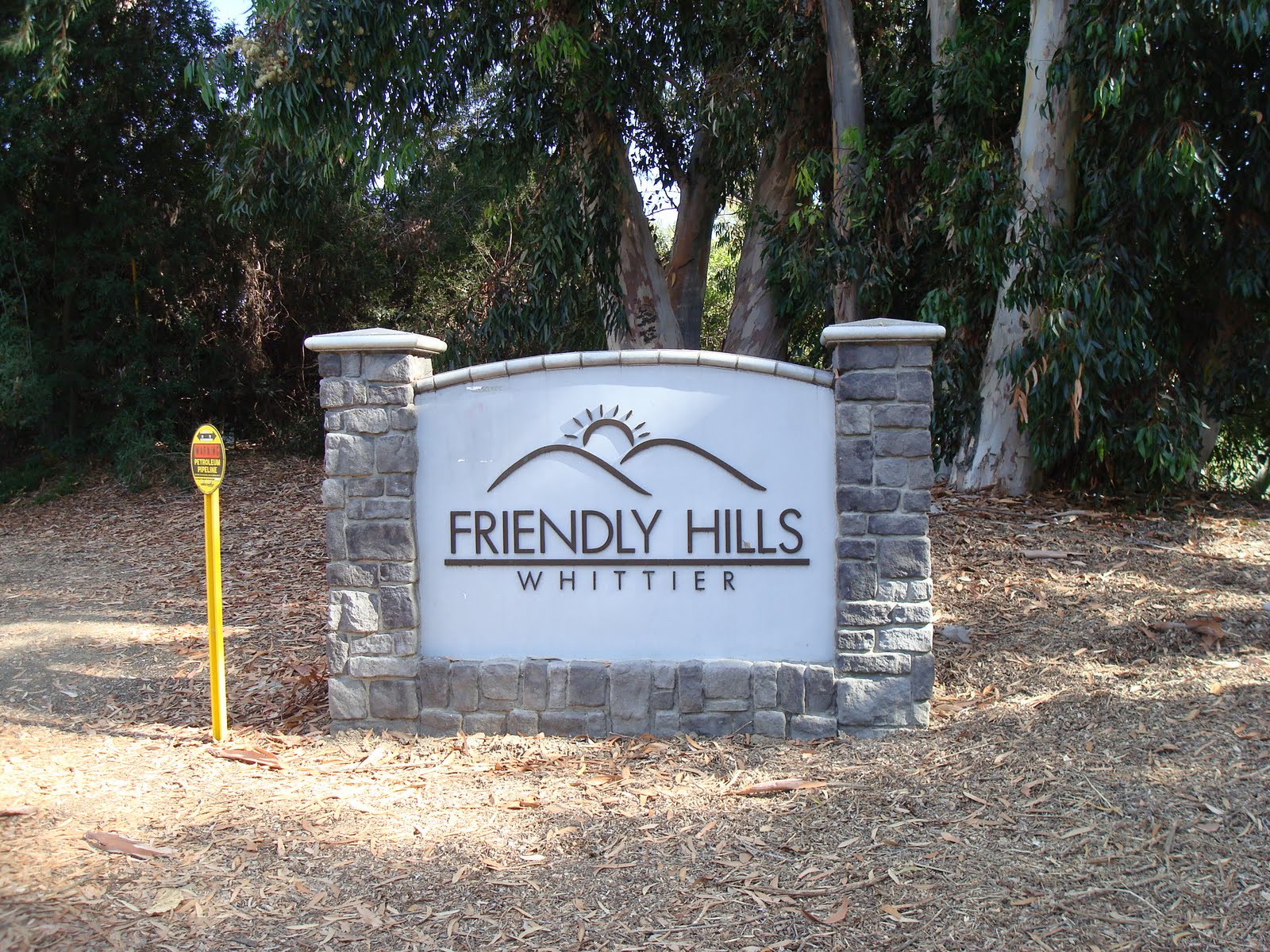 |
| By 1954, Murphy Ranch would eventually sell out completely to become a subdivision called Friendly Hills, homage to the Quaker community when the town was founded. Model homes had the names "Americana," "Bluegrass," "Contemporary," "Homestead," and "Thoroughbred." |
 |
| In 2008 Matrix Oil Corporation received a lease to resume oil and gas extraction from the Whittier Main Field, consisting of about 1,290 acres of city-owned land. |
 |
| Concerned citizens have many issues, including a desire to maintain the Puente Hills as open land for wildlife habitat. |
 |
| Some of the region's oil-bearing history in 1922. (Image from the Library of Congress American Memory website.) |
 |
| Oil pumps in Montebello, a neighboring city, continues such activity, across from a busy shopping center at Montebello Boulevard. |
 |
| More oil pumps. |
 |
| Close-up of another "grasshopper" further down the hill in Montebello. |

