Showing posts with label Downtown. Show all posts

Sunday, September 18, 2011

L.A.'s Bunker Hill: the Historic Wall of the Fremont Hotel

Bunker Hill observer Arnold Hylen once wrote that the hill and its neighbor Fort Moore Hill “rose like a spine in the center of old Los Angeles.”

Developer Prudent Beaudry (French-Canadian, former L.A. City Mayor) named a street "Bunker Hill Avenue" in 1874 to commemorate the upcoming centennial of the Revolutionary War battle.  The area was referred to as Beaudry Highlands or Olive Street Hill, but the Bunker Hill name stuck.

Joined by his younger brother Victor their land development ventures grew to prolific proportions and included contiguous regions north and northwest into present day Chinatown and Echo Park. The brothers had ample land holdings by the time of the frenetic Land Boom of 1887-88.

By the late 1890s, the area became an emblem of urban blight characterized by a changed residential make-up from affluent mansions to transient boarding houses. As early as 1912 proposals were made to drastically alter the residential neighborhoods on the hill. 

In 1959 the city council adopted the Bunker Hill Renewal Project, which set in motion a wholesale obliteration. By the mid-1960s, the hill was emptied, and the former grand mansions, converted rooming houses, hotels, apartments, and other streets and structures were moved or demolished.

Today, a city sign promotes the history of the erased neighborhood.


Visitors and Angelenos alike appreciate the downtown sites for its photo iconographic appeal:

Photographers at the corner of Spring and First Streets.
Contemporary Walls

Several blocks northwest of Spring and First is the equally photogenic Bunker Hill.  Shown are views of two current occupants:
A south wall of the Museum of Contemporary Art from Grand Avenue
Pictured here is the sleek facade of the Colburn School, next door to MOCA
The Historic Wall

Down the southern slope of Bunker Hill at Fourth and Olive Streets there is a nearly 110 year-old limestone wall once a part of the Fremont Hotel that opened October 1, 1902.
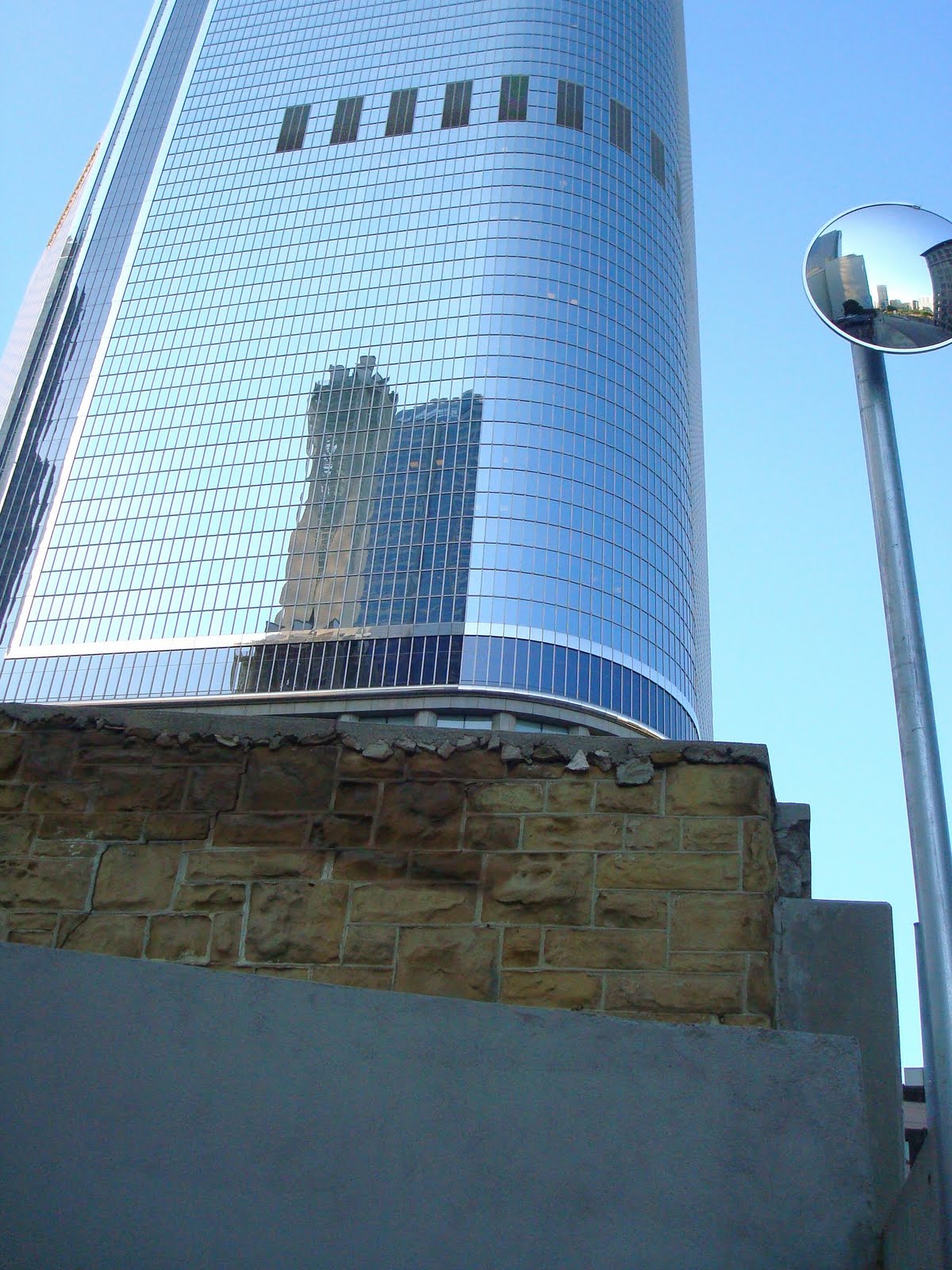


The wall from the hotel that once sat here on the west side of Olive, just south of Fourth Street


A shot of the wall from its opposite side, covered with late 20th century concrete
Photographers did not converge to this wall on this particular afternoon as I was the lone person paying homage.  The wall has been previously pointed out on the website On Bunker Hill.  The hotel was an early casualty in the establishment of a parking lot.  According to the website, its demise occurred in the mid-1950s.

The hotel opened in October 1, 1902 and was located at 401 So. Olive Street
[Update 12-6-2016:  George Wharton James wrote in an Out West publication, 1903, Fremont in California, that the hotel was named for John C. Fremont and that the hotel opened September 9th, 1902, on California's admission day).  Fremont's widow, Jessie Benton Fremont, supposedly was the first to sign the hotel register.]

Tuesday, August 3, 2010

The Orsini at Figueroa


The Orsini Complex at West Cesar Chavez and Figueroa is monumental in its 21st century form.  Prudent Beaudry would have understood and admired the drive of Palmer Boston Street Properties' development in the area. Beaudry was the prolific 19th century land developer who gave us Bunker Hill, the Beaudry Tract, the Park Tract, the Rosas Tract (in today's Chinatown) and other subdivisions, as well as his service as Mayor of L.A. from 1874-76.
(Click on images to zoom in)
In 2003, the Orsini developers unfortunately demolished "the last 19th century Bunker Hill home" in this area, the 1887 Giese House.  The house was most likely located on Prudent Beaudry's West Rosas Tract, which he and his brother Victor began promoting in 1883.
Pictured is another view of the Orsini.  Victor Beaudry would have appreciated the view from above.  He sold land west of here to another developer in what became Angelino Heights.
For countless years remnants of L.A.'s past could be found at the vacant lots along the north and south sides of West Cesar Chavez Avenue, as well as a short distance west at Sunset Boulevard's starting point.  Structures had long been demolished, leaving only short sets of concrete steps and retaining walls.  Pictured is one of those lots, taken in 2000, formerly at West Cesar Chavez and Grand Avenue, directly across from the former L.A. Unified School District offices, and just one block east of the current Orsini complex.
Today this site has been developed.
The following set of color photos (also taken in 2000) show the vacant site with mature palm trees, a remnant of a stone structure, and concrete curbs delineating an old driveway or carriage way.  Shown in the background of this photo is the former L.A. school administrative offices.