Showing posts with label theaters. Show all posts

Tuesday, September 7, 2010

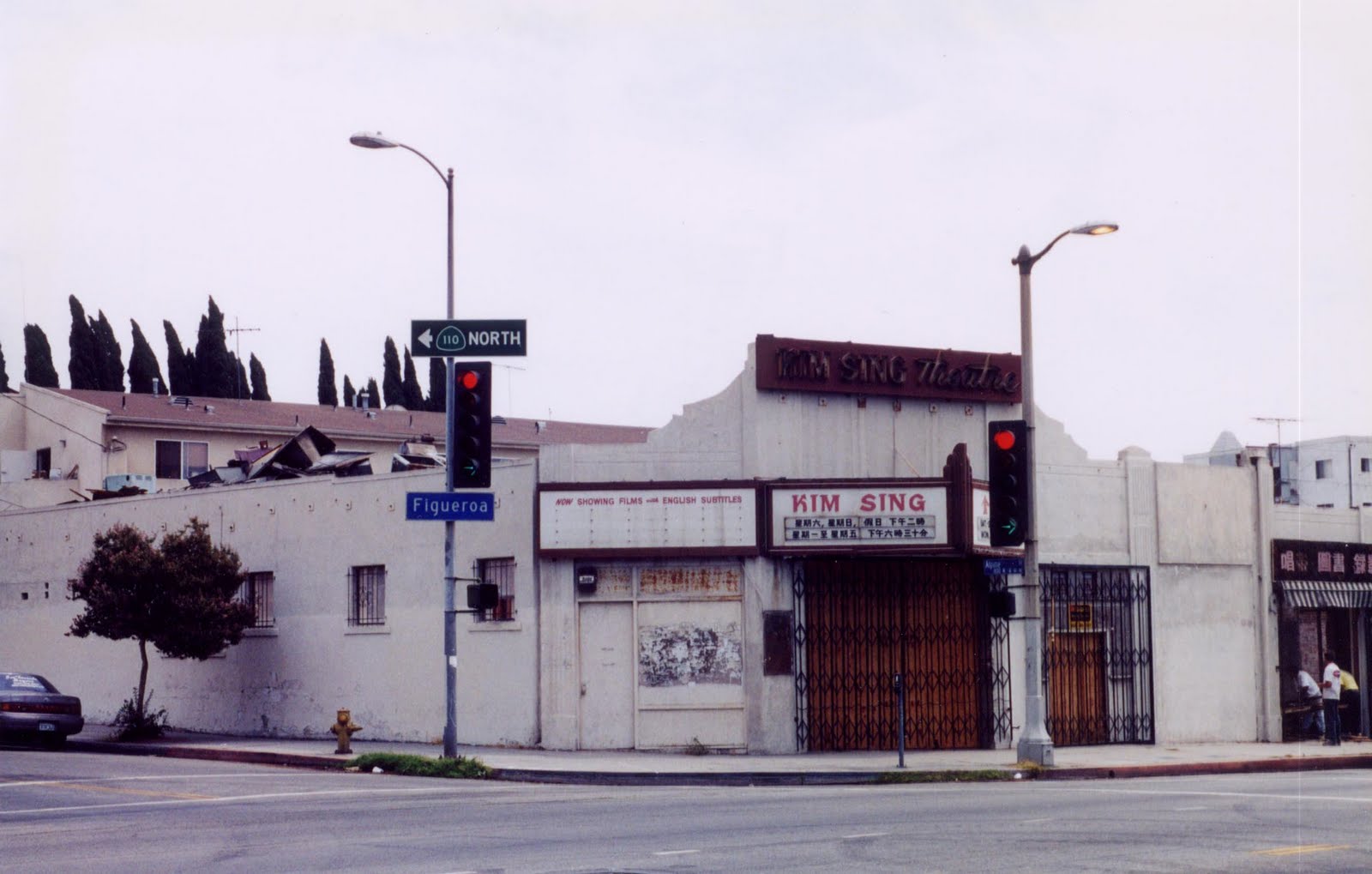
Kim Sing Theater

My inaugural post to this blog pertained to the views of City Hall, and the Kim Sing Theater was mentioned.  It is one of those buildings that escaped demolition owing to a historic building preservation code in place.  Down the street though, at Figueroa and Sunset, more than one structure fell victim to the mammoth footprint of the residential structures of the Orsini development in recent years.


I have personal memories of the theater, and I was curious to learn what others remember.  Visit the Kim Sing Theater & L.A.'s Chinatown page above to read the stories.


These photos were taken in 2002, at which time the interiors were already being worked on.
(Click on the image to zoom in)


Sunday, August 8, 2010

The Early Entertainment Complexes of Henry Jensen

The German-born Henry Christian Jensen is described in an earlier posting as an established brickmaker by the close of the 19th century in Los Angeles.  The proliferation of moving pictures after 1910 brought a new business opportunity for Jensen and Sons:  building movie houses.  One of the most celebrated buildings still standing is the Jensen's Recreation Center on Sunset Boulevard in the heart of Echo Park, which was constructed in 1924.  It is an early example of today's shopping mall or entertainment complex:  when it was constructed, the Center had shops, apartments, a bowling alley and a pool hall.

Ten years earlier, Jensen built the first movie theater in Glendale, the Palace Grand.  He then constructed the Raymond Theatre in Pasadena, which opened April 5, 1921.  In Hollywood, he built Jensen's Melrose Theatre (currently a Ukranian Culture Center at 4315 Melrose Avenue), date unknown.

Information on Jensen also mention Jensen's Theatorium in Echo Park (currently a grocery store), with a possible building date of 1912.  In 1930 the entertainment venue was owned by Turner, Dahnken and Langley (TD&L), a syndicate which later became a core of the conglomerated Fox-West Coast film-exhibiting circuit.  [Update 10/26/2016:  the Theatorium may have become the Hollyway, shown below, a stone's throw from the Recreation Center.]


The Hollyway shown above.  Photo from Los Angeles Saturday Night, 150th Birthday of L.A. edition, 1931
Courtesy of the Seaver Center for Western History Research


Of the buildings mentioned above, it is the early example in Glendale that has not survived.  Palace Grand, (located in the newer street numbering system at 131 and 133 North Brand Boulevard) was purchased by TD&L around 1923.  (Some sources estimate that Palace Grand was torn down before World War II.)  However, Jensen may have reconstructed portions of the theater or had found new construction adjacent, because a new storefront appeared in the 1920s called "Jensen's Arcade" or "Jensen's Palace Grand Shops."  Like the Recreation Center in Echo Park, the Glendale venue had shops on the main floor, a bowling alley and billiard hall in the basement, and a popular dining spot on the second floor:  the Egyptian Village Cafe.

In a draft historic preservation document published by the Planning Division of the City of Glendale, about 1975, the second floor Egyptian Village Cafe was recommended for preservation.  (Click on images to zoom in)

Second Floor Interior
The recommendation of the city's historic preservation element was not successful, because the building was subsequently torn down in an undetermined year.
Sunday, August 1, 2010

Views of L.A. City Hall

L.A. skyscrapers have long since surpassed City Hall, once the tallest building of Los Angeles but which continues to be a city icon.
The corner of Spring and Ord Streets provides a generous pose of City Hall. Ord Street was named for the Army Lieutenant Edward O.C. Ord, who was hired to create American Los Angeles' first land survey in 1849. Before then, maps called diseƱos were used by Spanish and Mexican property owners.

Spring Street was formerly Calle Primavera. Earlier, between 1825 and 1835, it was called Calle de Las Caridad (street of charity) for the wealthier residents who lived there and subsidized the poor. An even earlier name, circa 1800, was Calle Ciudado (Lookout or Beware Street) due to the numerous washes and gulches.

Ord return to Los Angeles in July, 1856, under orders to assess the temperament of the Indians and to recommend where a military post was needed. By then he was Captain Ord, and the trip included stops at Chino, San Bernardino, Jurupa, and the San Gorgonio Pass. He eventually determined that the San Gorgonio Pass would benefit from the protection of a post, but only if the Pass was deemed a viable transporation route.
Standing in Little Tokyo before the tribute plaque to Astronaut Ellison S. Onizuka, City Hall is in view. The ill-fated 1986 Challenger spacecraft accident marked a dark day in space travel. That very street, named for Onizuka, was formerly Weller Street, a spot in the 1850s where horse-drawn travel drew competition among stagecoaches.  The drivers tore past on the last legs of their journeys before arriving the Bella Union Hotel on Main Street, filled with passengers from the San Pedro Harbor. Prior to 1910, Weller Street was Wilmington Street.
ABC Restaurant operates in the building that was formerly the Limehouse. It morphed into a typical late 20th century Chinese restaurant. I recall dining at the Limehouse occasionally as a child in the early 1960s. I remember a special dish they served that I never had elsewhere: paper-wrapped chicken, and it was wrapped with wax paper to seal in the delicious juices.  (Click on images to zoom in)
Gone is the patio where glamorous couples dined and danced to Hawaiian music, as the back of this matchbook cover image advertises. There is City Hall in view, as promising as the crescent moon and stars.


Above is the current restaurant at the Limehouse site. The proprietors of the old Limehouse still own the building.

Kim Sing Theater, at 722 No. Figueroa Street, along the northwest perimeter of Chinatown, was a Chinese movie house. The structure dates to 1925.  Originally the 475-seat theater was called the Alpine before being renamed the Carmen in 1941.  In the 1950s the theater was screening Chinese films, but by 1952, the theater became Kim Sing. As a young child in the early 1960s, I accompanied my parents there. Kim Sing was the oldest of the three movie houses in Chinatown at the time. I remember the really old theater seats. From the arrow in the picture you can see the tapered top of City Hall peeking through.