Showing posts with label LAPD. Show all posts

Thursday, August 31, 2017

Señor Botello at Olvera Street

Olvera Street has been a colorful destination for downtown office workers, locals, and out-of-town visitors since it opened on Easter Sunday of 1930.

This postcard translates a quaint, bucolic scene that Christine Sterling envisioned.

Notice City Hall looming in the background.
Courtesy of Seaver Center for Western History Research
Since the founding, Olvera Street has generated mixed opinions.  Notably in recent years, Dr. William Estrada's Los Angeles Plaza, a Sacred and Contested Space (Austin:  University of Texas Press, 2008) and KCET's "Olvera Street:  a Fabrication of L.A.'s Mexican Heritage" by Alvaro Parra have offered insightful historical analyses of the Street.

Tourism companies promoted the place of course.  Commercial photographers angled their cameras and framed the Spanish dancers, their guitars, sombreros, burros and the marketplace.  Adelbert Bartlett was one of those photographers.  Based in Santa Monica, a lot of his work was focused on the southern California lifestyle, according to the UCLA library that maintains his collection.

The Seaver Center at the Natural History Museum also holds a small number of his photographs, such as the one below.  A picture is worth a thousand words but not in this case.  Who was this man in the photo?


Mexican American Police Officers
Thomas Botello was identified on the back of the photo as a pioneer of Los Angeles, native of the Plaza district, shown drying gourds at the Avila House.  The photo lacks a date, but Bartlett may possibly have taken this around 1929 prior to the opening of "Olvera Street".  Courtesy of the Seaver Center

Adelbert Bartlett often photographed crumbling adobe buildings along with their aged inhabitants.  The good thing is that he often provided identification of names and places. 

For this blog post Thomas Botello's life has been pieced together from census records, city directories and the many available newspaper accounts despite discrepancies in dates and details.  Name variations included Thomas F., Thomas T., Tomás, and Tommy.

His Mexican American Heritage

Thomas, along with his brothers and a sister, as well as their mother, were born in California.  The mother, Concepciona, was born about 1832 according to the 1870 census, but it appears that all the children were born in the decade or so following the state's admission into the Union in 1850.

Thomas was a nephew to Narciso Botello (about 1813-1889) who appeared in historical accounts:  Narciso came north to Alta California in the Mexican colonial period.  Internet sources state he was Chief of Staff to General Joaquín Ramírez y Sesma.  He then became a member of the L.A. municipal council called the Ayuntamiento, and he again sat on the Common Council during the new American era.  Narciso compiled several manuscripts on daily life in Mexican Los Angeles, and today historians rely on these works as a window to the 1830s and 1840s.

Narciso's great great grandnephew, Stanley E. Botello (1921-2015), told contemporary Narciso manuscript translator, Brent C. Dickerson, that Narciso's two brothers Pedro Ysais Botello and Jose Refugio Botello both married the two daughters of a Lieutenant Jose Maria Ramirez - the daughters were Maria Concepcion Eligia and Maria Ygnacia respectively.  Both couples' marriages took place in Los Angeles.

Pedro & Concepcion supposedly married in December, 1858.  Presuming Thomas was the third child of this couple, his date of birth mentioned in his obituary placed his birth before the parents' marriage.

His Career in Law Enforcement

Thomas' obituary published June 27, 1935 began with the headline Veteran Peace Officer's Funeral Will Be Today:  "In point of continuous service he was the oldest detective in the United States, having served from 1878 to 1930.  He was a native of Los Angeles, born here June 29, 1858.  As a youth he joined the Southern Pacific detective forces and soon became special agent in Mexico for the Wells, Fargo Company.  He also served as Los Angeles county deputy sheriff through several administrations, as police officer under four chiefs, deputy United States Marshal and at the time of his death was special deputy Sheriff."


Portrait from Los Angeles Times, March 18, 1906
If he indeed found work as a policeman in 1878, he was about 20 years old.  The police force had matured in the growing city stung by rioting in 1871 (resulting in the mob violence and murder of Chinese residents - news that took national attention away from the ongoing Great Chicago Fire.)

The LAPD was organized in 1877, doing away with the L.A. City Marshall position.  But the police maintained a reputation for corruption and brutality.  Between 1889 and 1900, Chief John M. Glass developed a professional force under his leadership, but when he departed, the officers were often controlled by the politicians in order to control elections.  Progressives, though, voted in the advent of municipal civil service rules for the hiring of officers.

In tracking newspaper articles about Thomas, throughout the 1880s he worked in Los Angeles in various capacities of law enforcement, but he was also a detective of the Southern Pacific Railroad in Mexico.

In 1890 he was still associated with the Southern Pacific.  In preparation for the July 4th parade in L.A., Thomas got the assignment to accompany and oversee a group of Native Americans from Yuma, Arizona, who traveled up on the railway to participate in the parade.  (They disappointed the parade onlookers, as the newspaper expectantly wrote that the group did not each don "a gee string and a strip of red calico."
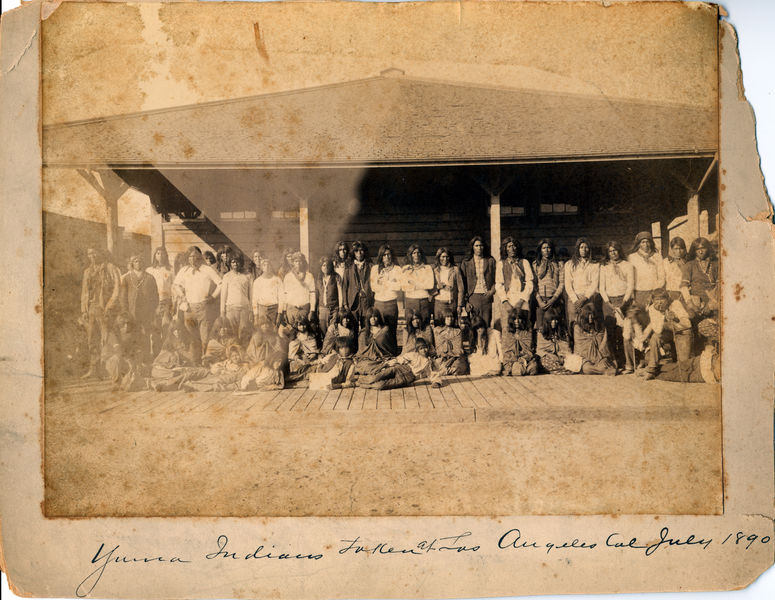

The group in front of train depot or the Panorama Building, 220 So. Main Street
Courtesy of the Seaver Center
In 1891, he was a detective on the Mexican Central Railway, and by June, the paper announced he was a detective for Wells, Fargo & Co.

Los Angeles Herald, June 2, 1891

By 1900 he was back in Los Angeles, conducting boat patrol around Avalon Island and also working as a Deputy Constable. 

Also about the year 1900 Thomas opened his own detective agency in the Bullard Building located at 156 No. Spring Street.  He operated independently into 1920 according to city directory listings.

Billed as "Thomas T. Botello"
To re-cap, the numerous newspaper articles reported on Thomas' arrests - of a shoplifter; of robbers upon Wells, Fargo; of a couple for murdering a man; of a man in Ventura County for attacking another on the L.A. & Ventura Stage Road; capturing robbers of a Mexican train, mail fraud perpetrators, a counterfeiter of government stamps; the chasing of stage robbers while he was chief of the Wells, Fargo & Co.'s detective force in Mexico.

The paper also reported on his testimony against charges of police corruption against Chinese gamblers; another testimony as a witness involving Democratic voters who were deterred during a local 1887 election; a scuffle he was involved with another bailiff in the U.S. Circuit Court.  Thomas was himself accused of bribing a voter.  He and several fellow officers were arrested for burglary and larceny against Chinese gamblers:  though they had a warrant for arrest, they broke a number of houses, destroyed property but found no evidence of gambling.

Thomas was a member of the Hidalgo Club that planned periodic Mexican Independence Day celebrations.  He was also a vice president of the local Spanish-American Democratic Club.

The 1930 census listed him as unemployed (as he was about 72 years old).  A few city directories between 1928 and 1931 list his occupation as clerk.

Perhaps he picked up some income drying those gourds at the new Olvera Street.


A Volatile Family Life

Thomas married a local girl, Cleofas Boring, at least by 1888 (in the 1883 city directory, he was living at Uncle Narciso's place in East Los Angeles while Miss C. Boring was listed as a dressmaker living at 135 Buena Vista).  She was a few years younger than Thomas, and her bad temperament was recurring news.  In the summer of 1888, she and two others appeared in court for disturbing the peace.  The two defendants were let go, but Cleofas was fined $5.00.

In November of 1891, the couple was living at Cleofas' parents house at 549 Buena Vista.  It was reported in the paper that she stormed into a neighbor's house, brandishing a heavy pitcher.  As she wreaked havoc around a room, she splattered flammable coal oil before she ran out.  The woman neighbor managed to put out the fire before endangering her children and a bedridden old woman.  The Times reported that Cleofas' husband, Tom, ex-Detective of the District Attorney's Office, was away in Mexico City.

The Los Angeles Herald announced March 24, 1895 that the couple filed for guardianship of an illegitimate child of a poor woman who did not have the means to raise and educate him.  The boy was given the name Thomas F. Botello.

The older Thomas' home life was at times tumultuous as when was out accosting criminals.  In January of 1896, a sensational newspaper article reported that "Tommy Botello Shot His Wife in the Leg."  Deputy United States Marshal Thomas claimed it was accidental when a .44 caliber resolver discharged during an argument in their home at 216 Wildardt Street.  The newspaper chronicled that the wife arrived home 11:30 in the evening drunken and belligerent.  In the morning she threatened to tear up a Federal bench warrant that he was supposed to serve that morning, and she lunged at him with scissors, and in the scuffle the gun went off.  Cleofas told an opposite story that in actuality it was her husband who was the long-time abuser.

Little Tommy, about 10 years old, was reported in August, 1897 to have attempted to run away from their home at 721 Castellar Street.

Their address changed every couple of years.  The 1897 directory also listed them at 1428 Maple Avenue, their longest stay, until 1901.  Throughout their lives, they primarily lived within a mile or so of the plaza, though between 1912 and 1918 their address was in Hawthorne.

Another story in the L.A. Herald August 26, 1898 mentioned that the wife of Thomas F. Botello, ex-U.S. Deputy Marshal, demolished crockery, furniture and broke down doors while intoxicated.  As she heaved a lamp at Thomas, it missed him but hit their little boy.  Police intervened and tried to take her to her parents' house.  She resisted and was charged with disturbing the peace.

Below is a 1916 newspaper photo identifying the naval soldier on the far right as bugler Thomas F. Botello - presumably this was the son.

From the Los Angeles Times
Thomas and Cleofas were still listed together in city directories, the last one being 1934.


A Mysterious Adobe by the Broadway Tunnel

The city relieved its traffic congestion by digging a tunnel through Fort Moore Hill in late 1899.  By 1901 the new tunnel allowed a connection to North Broadway. 

Oddly, a Mexican adobe sitting at one end of the tunnel was spared in the construction (once the home of Cleofas and her parents, Henry Boring and Isabel Acuña).  The extraordinarily wide tunnel underwent repairs in its mid-life including remediation of dampness and mildew until it was closed in 1949 with the coming of the freeway.


April of 1919
In 1919 a newspaper article detailed the sale of the adobe to businessman John Dye.  The news story went on to say that part of the appeal to Dye was the history behind the structure:  it supposedly belonged to the family of Thomas Botello, whose family emigrated en masse in 1849.  Botello was quoted that his grandfather was a General.

Knowing what we know about Botello's background, the story seems to have been fabricated, perhaps in order to make the sale more attractive to Dye.  Botello's parents were already in Los Angeles by 1849 when the U.S. war with Mexico was over.  Actually, the house was probably owned by his wife, Cleofas, whose grandfather was a Lieutenant Ramirez.


April of 1919

The adobe can be seen below, with "Dynamite" billboard above and another billboard along one side of the house, to the left of the tunnel.


Circa 1928 view of the Broadway Tunnel at Sunset Blvd.
Courtesy of the Los Angeles Public Library Photo Collection

The adobe seen above was described in Marion Parks' article "In Pursuit of Vanished Days, Visits to the Extant Historic Adobe Houses of Los Angeles County" in a publication of the Historical Society of Southern California (1928, vol. 14 no. 1-3).  Parks wrote that the house (at the address 412 Sunset) sat between Justicia Street and Broadway, at Sunset, built in 1864 by Francisco Garcia (who lived to 115!) using adobe bricks made by Francisco Manzo.  The house then became the home of the Borings, the birthplace of daughter Cleofas.

Here is another photo showing the dilapidated structure:

ca. 1920 (GPF.6760)

The image below, dated about 1935, is a similar view without the adobe, leaving only the Auto Park.

Courtesy of California Historical Society, USC Libraries


Tuesday, June 14, 2016

Beneath Parker Center: the Paris Inn Café, Little Tokyo, Vigilantes & Mexican Immigrants

The future for the vacated Los Angeles Police Facilities Building on Los Angeles Street is still undetermined.  The modern, postwar, Welton Becket structure opened in 1955 and was posthumously named Parker Center in 1966 after the death by heart attack of Police Chief William H. Parker.

This post will dig, historically speaking, beneath the block where Parker Center stands, encompassed by Los Angeles, Temple, Judge John Aiso (formerly San Pedro) and First Streets.
An aerial view as seen on the Los Angeles City Model (ca. 1938-40),
currently on display at the Natural History Museum's Becoming Los Angeles exhibition

The Paris Inn Café on Market Street

A minor street once ran east-west until sometime around the 1952 groundbreaking - Market Street.  From its beginning it was a short street, and by the 1950s it probably only ran from Main to San Pedro.  (After Parker Center was opened, however, a 1956 city directory listed a main post office at 333 Market Street.)

Within the city block was a popular dining establishment, the Paris Inn Café, completed near the corner of Market and Los Angeles streets in late 1929 (210 E. Market) and formally opened in March of 1930.  The business was moved in 1950 to Chinatown at its third and final location (845 N. Broadway), leaving the unique French chateau to face the bulldozer.

The Café's original location was a block west, at 110 E. Market.  Madam V. Zucca began operating it in 1922, and the business changed hands to Bert Rovere, Innocente Pedroli and other new owners in 1924. By the time the new City Hall opened in 1928, the Paris Inn was just across the street; the café had seen raids in violation of "dry Sunday"; dining entertainment included an orchestra, acrobatic dancers, a singing cigarette girl, Rovere himself billed as California's best baritone, dinner dansant (dancing held during afternoon tea); and the place served French & Italian dinners.

The restaurant was keen on publicity:  their Paris Inn Café orchestra was featured on KHJ radio along with other local groups including the Leighton's Arcade Cafeteria orchestra.  Bert Rovere promoted his operatic voice and athleticism like in a 1927 article reporting on his training for a Catalina Island swim.

The entertainment offerings continued as the new restaurant down the street was being completed:  Mystic Madame mind reader, fortune telling, singing waiters, and Apache dancers.  On March 26, 1930, a celebrity-studded grand opening of the new Paris Inn was broadcast on radio station KTM.  Within a few short months, the new location was raided by Prohibition officers.  Soon the charges against Pedroli and Rovere were dropped.  By the end of the year the restaurant was allowed to re-open. The following year Mexican star Carla Montel was hired for their Paris Inn revue.  In 1932, publicity built up for the largest patron turnout yet at the second anniversary party.


Postcard postmarked June 8, 1934
From blogger's collection

Paris Inn customers included football and auto-racing guests, and the papers often reported the local Italian colony hosting meals in honor of its special guests.  In January of 1931, a waiter race was reported to be held on Washington's birthday on a race route from the Southern Pacific station to the Inn - competitors carried a tray, a bottle of milk and a goblet.  Out of 60 waiters, the winner was Mr. Apollo.
Paris Inn at 210 Market Street, Los Angeles
Courtesy of the Seaver Center for Western History Research


Paris Inn (from magazine)
Courtesy of the Seaver Center
Interior with singing waiters by the Eiffel Tower
Courtesy of the Seaver Center

Courtesy of the Seaver Center
Postcard image added 10/23/2017
From blogger's collection


Postcard reverse side image added 10/23/2017
At upper right it states "Hand Card to Waiter and we will mail it for you."

First and San Pedro Streets - the Historic Heart of Little Tokyo

Japanese American residents, businesses and organizations were displaced for the new Police Facilities Building.  The City Planning Commission decided this in 1950, and some residents called it a "second evacuation" of the 1,000 tenants, including those in the Olympic Hotel.

By 1907 this intersection was a central point of the growing district of Little Tokyo with a population of 6,000.  By 1930, most of Los Angeles County's 35,000 Japanese and Japanese-Americans lived within three miles of this center - partly due to the prejudicial hostilities in areas beyond.  Below is a photograph looking out from the corner of First and San Pedro, showing the structures in the process of being cleared out:


The corner business in the foreground was the First and San Pedro Department Store, circa 1953
Courtesy of the Seaver Center (P-011-3ov)
The 1925 Olympic Building once sat at 117 N. San Pedro - the 1930 and 1942 city directories listed a Japanese Chamber of Commerce in the building.  It also contained "the finest hotel of that era", professional offices of doctors and lawyers, and stores including Mikawaya Confectionary.  In the photograph above, the Olympic Building had been demolished (far right shows cleared land).  (Today the segment of San Pedro between First and Temple has been renamed in honor of Judge John F. Aiso).

Using the above photograph as reference, on the upper left would have been the Japanese Daily News of Los Angeles (Rafu Shimpo) located at 104-108 N. Los Angeles Street, where the newspaper had operated since 1915 or 1916.  It is a good thing the publisher's son was able to resume the newspaper beginning in 1946 after being released from internment following the war, while his father Toyosaku Komai remained at a New Mexico detention center:  the building would be intact for another handful of years and Komai had hid the Japanese type apparatus under the floors!  (For more information, read Little Tokyo:  One Hundred Years in Pictures).

View of First & Judge John Aiso Streets taken June, 2016

The naming of a segment of San Pedro Street in remembrance of  Judge John Aiso enabled the community to take back part of what was lost in the 1950s - because he was the first Japanese American judge, but also unfortunately Mr. Aiso succumbed to head trauma from a violent attack in Hollywood.

Don Manuel Requena & Requena Street

In 1923, the Busch Pipe & Supply Co. occupied the address of 150 North Los Angeles Street (later to become the address of Parker Center).  The map below shows a much earlier structure - that of the Requena Block.  A merchant, Manuel Requena (born about 1802 in Campeche, Yucatan) was the landowner - more on him later.

Market Street's name came about through a petition filed in July of 1904 by the merchants along North Main Street.  The City Council approved changing out Requena to Market.  Before that, the original length of the street was called Libertad.

The Requena Block - Manuel Requena's building along Los Angeles Street
shown on the lower portion of an 1870 map courtesy of the Seaver Center

An 1894 ad in Charles Lummis' Land of Sunshine periodical provides a glimpse further back in time of what was here -  the Union Gas Engine Company specialized in irrigation, mining and marine equipment at 114 Requena Street.  Requena Street was also where the zanja madre (mother ditch water source) flowed, making Manuel Requena's property a prime location.


Don Manuel Requena
Image courtesy of the Seaver Center

He was an orange grower, too, but today his contemporary, William Wolfskill, is primarily remembered for early citrus culture rather than Requena.  Thomas O. Larkin described Requena positively in this way:  "trader and farmer...born in Yucatan...a man of property and much general information and influence...not anxious to be in public life unless strongly urged, not anxious for salary."

He was elected as one of the trustees for the city's first school - a schoolhouse was constructed in the mid-1850s, according to Harris Newmark as "way out in the country" - at Second and Spring Streets.

He was a cattle rancher.  Shown are cattle brands registered by him in the 1850s:


Requena's cattle brand and ear notches recorded with the
Registrar-Recorders Office in 1852
Courtesy of the Seaver Center
Another set of cattle documents recorded the following year (1853)
Courtesy of the Seaver Center

He died in 1876 a widower and without offspring.  His wife Gertrudes Guirado (sister of Rafael Guirado) died two and a half years earlier.  In the 1870 census, Requena's household comprised of himself, his wife and a Chinese cook, Jo Ah.  Neighbors listed on the same census also had Chinese cooks.  This blogger wonders whether Requena and others employing the Chinese were served somewhat Chinese meals.  This blogger also wonders if some of the cooks became victims of the 1871 Chinese Massacre in the city.

Manuel Requena was in Guaymas, Sonora in the early 1830s.  He turned down an administrative job at the Guaymas customs office.  He partnered with Englishman Richard York to sail a ship they co-owned up to California and pick up hide & tallow before heading to Chile.  With immigrant passengers on board, everyone arrived sea sick from a voyage that began March 1834 and arrived in San Pedro in July.  Requena decided to stay put in Los Angeles.

During the same year, the politically controversial Hijar-Padres Colony party left San Blas on August 3rd aboard the ship Natalia.  Among the 239 members of the group was Frenchman Victor Prudon (who would soon become Requena's adversary in Los Angeles).  In 1835 the Mexican government declared Los Angeles from pueblo to ciudad.  Moreover, the same decree also designated Los Angeles as the new capital of Alta California.  The threat to the power seat in the Monterey capital coupled with immigrants streaming to Los Angeles did not sit well with the northerners in Monterey.

Violence & Vigilantes

By 1836, Requena was alcalde (mayor).  He later served a second term in 1844, but in late March, 1836, he was in a grave situation:  a vigilante committee formed comprising of upstanding citizens outraged by the murder of Domingo Feliz allegedly by his unfaithful wife and her vaquero lover.  An L.A. Times article published January 30, 1921 recounted the ordeal:  Requena and the Common Council went to investigate a missing person, discovered Feliz' body, and eventually arrested a man and woman.  French emigrant Victor Prudon led the push to pressure Requena to execute both individuals.  Requena refused, and the mob took matters into their own hands, lead the accused to an outside jail wall and shot both.  (For more information on this topic, see Eternity Street:  Violence and Justice in Frontier Los Angeles, by John Mack Faragher, W.W. Norton, New York, 2016).

*       *      *

As the victorious Americans occupied the city following the U.S. War with Mexico in 1849, Requena was a member of the Common Council when they approved to hire surveyor Lieutenant Edward Ord for the first survey of Los Angeles. 

He was an objecting voice in 1850 when the northerners of California wanted to proceed with statehood for California without enabling the southern part of California to weigh in on the matter.

When the Los Angeles County Board of Supervisors was formed in 1852, Requena served on the first board, along with New Mexican Julian Chavez.

New image added 7.31.2024 that shows Liberty Street next to Requena's property:

Source:  Los Angeles County Public Works Land Records Information:  Clerk Filed Map No. 20, undated